Water saving advice
Water is a precious resource for us to use wisely
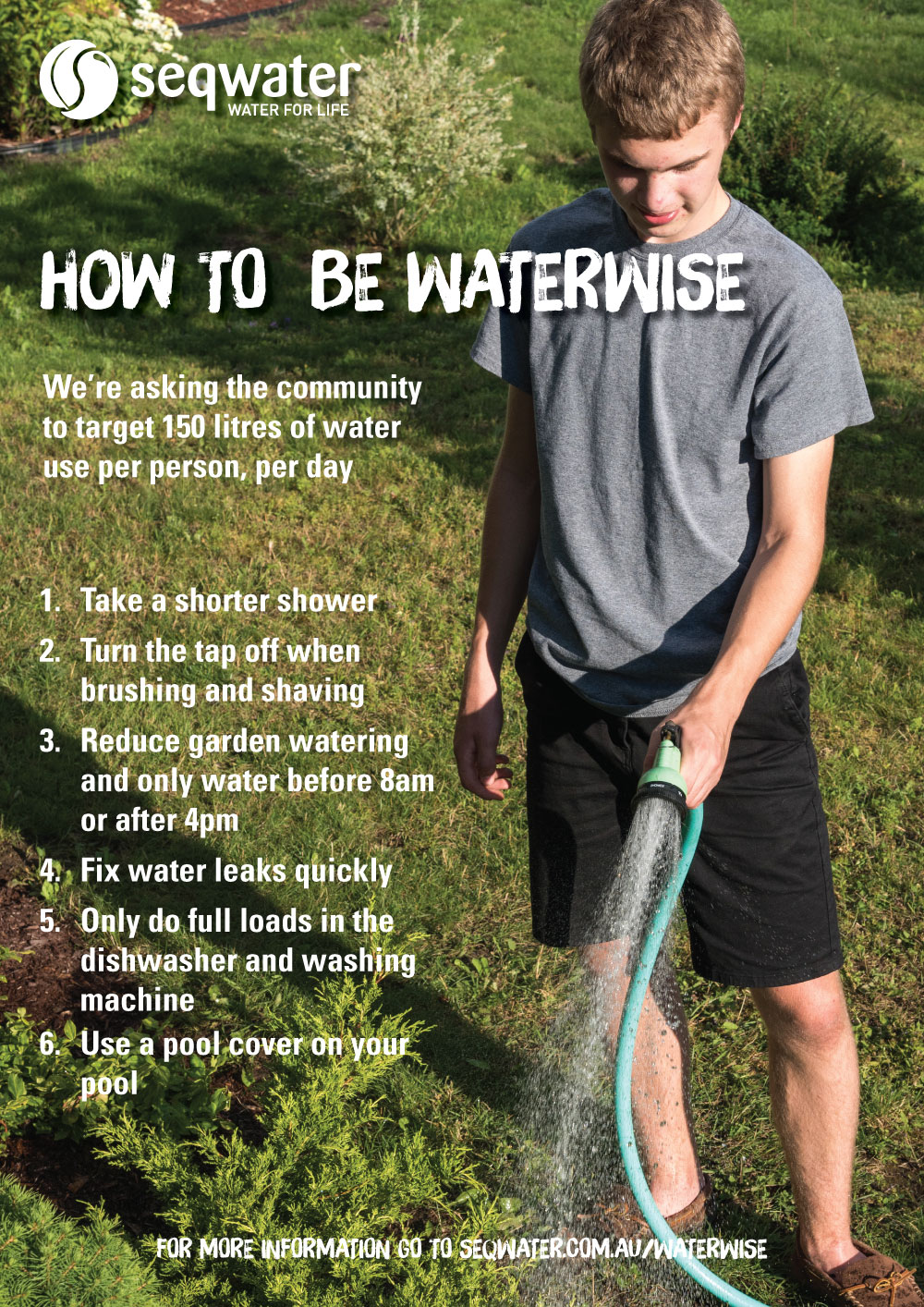
Paralympic gold medallist Alexa Leary shows how small changes can make a big impact. We all have a part to play - Be A Water Saver.
If one million people in South East Queensland make a commitment to save just three litres of water a day, we could save three million litres of water every day!
That's 15,000 bathtubs of water.
Water saving tips
Complete a home water audit
Do you know how much water your household uses? A home water audit could help. Get the family involved and do a water audit to see where you use the most water in the house.
General
- Fix dripping taps quickly.
- Check for a leaking toilet cistern.
- Understand your own use – check your water bill for your comparison.
- Where plumbing is required, contact a registered and licensed plumber.
Visit mpaq.com.au for a list of registered plumbers. - Choose water efficient washing machines, toilets, shower heads, dishwashers and other appliances.
- Check out how the rating works at waterrating.gov.au.
Indoors
Bathroom
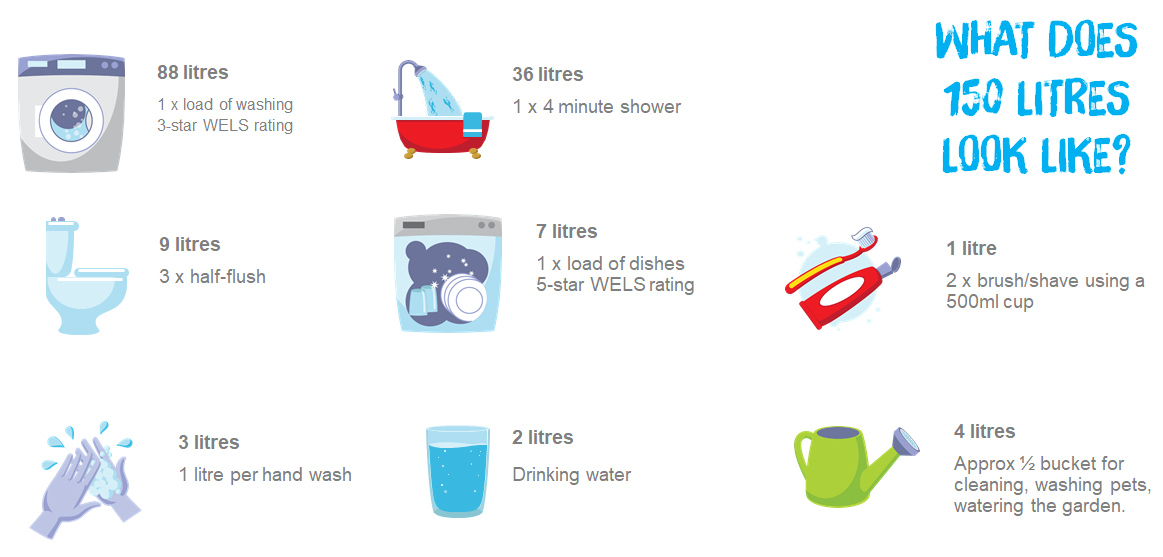
- Take a shorter shower. A standard shower uses around 9 litres of water each minute, about the same as filling a bucket.
- Install an efficient showerhead to save on water and energy costs. Older showerheads use 15–25 litres per minute, but an efficient showerhead uses just 6–7 litres per minute.
- Turn off the tap when brushing your teeth or shaving.
- Fill the sink with the plug for quick rinsing or washing. A simple switch that stops litres of water running down the drain.
Toilet
- Use the half flush when appropriate.
- When replacing your toilet, choose a dual‑flush. Single‑flush models use 11 L per flush, while modern dual‑flush toilets use 4.5 L (full) and 3 L (half).
- Avoid flushing rubbish and other waste. It wastes water, blocks sewers and can cause overflows that harm local waterways and ecosystems.
- Check for a leaking toilet cistern. A simple test is putting food colouring in the cistern. If the colour shows in the toilet bowl without flushing, you've got a leak.
Kitchen
- Avoid pre-rinsing dishes for the dishwasher – a good scrape is usually enough.
- Only use the dishwasher when it is full and if possible choose the eco cycle. A dishwasher uses the same amount of water regardless of the number of dishes in the dishwasher.
- Avoid peeling vegetables under running water. Use a bowl of water or rinse once peeled.
Laundry
- Only use the washing machine with a full load and on the most efficient cycle.
- When replacing your washing machine, choose a front loader. Top loaders use about 110L per wash, while front loaders use around 60L.
Outdoors
Garden
- Talk to your local nursery about improving the soil by adding organic matter and nutrients, mulching and planting appropriate species of plants and lawn.
- Aerate your lawn so it is ready to absorb any rain we receive.
- Use your rainwater tank for watering the garden and topping up the pool instead of drinking water.
- Use a hose with a trigger nozzle to target areas that need water and avoid overwatering. Remember to turn the hose off at the tap. If the nozzle pops off, it can waste 1,000 litres in an hour.
- Consider how much you need to water – many plants can tolerate less watering than you think.
- Use native plants where possible and select plants that can tolerate dry conditions.
- Water your garden before 8am or after 4pm – out of the heat of the day. You'll reduce water loss through evaporation.
- Pull out weeds as soon as they sprout. They take water away from your plants.
- Consider grouping plants that need the same amount of water together so none of them get too much.
- Water the roots of each plant, not the leaves.
- Add a 7–10 centimetre deep layer of mulch around your plants to help prevent water from evaporating.
- Use a timer if using a sprinkler or irrigation system regularly check it and and consider reducing frequency or install a moisture sensor to reduce irrigating when it rains. A sprinkler can use 900 litres every hour.
For advice and tips, visit:
- Water wise plants www.qld.gov.au/environment/water/residence/use/garden/plants
- Irrigation system advice www.irrigationaustralia.com.au.
- Efficient irrigation in an urban landscape - Department of Local Government, Water and Volunteers.
- Care and maintenance of rainwater tanks - Rainwater Harvesting Australia (a Division of Irrigation Australia).
Swimming Pools
- Cut evaporation by up to 90% with a pool blanket. A roller makes it easy to use.
- Carry out regular maintenance, including checking for leaks.
- Use your rainwater tank for watering the garden and topping up the pool instead of drinking water.
- Only backwash your filter when necessary. If you keep your pool and filters clean, you won't need to backwash as often.
Cleaning
- Use a broom, brush, blower or rake to sweep and clean outdoor paths and paving instead of hosing them down with water.
- Spot clean for safety, health or emergency reasons with a hose fitted with trigger nozzle or with high pressure cleaning equipment.
- Fill a bucket, and use a sponge to remove extra stubborn marks.
- Avoid using the hose to clean the driveway – use a broom or leaf blower.
Car Washing
- Use a bucket or a hose fitted with a trigger nozzle.
- Wash the car on the lawn, using biodegradable cleaning chemicals, to give your grass a good watering in addition to cleaning your car.
- Use a low flow/high pressure wash.
- Use a fixed automatic car wash service.
- Try using a waterless car washing product.
Industry and community groups
Business and industry
- Conduct a water audit to help you understand your use, identify unexpected patterns such as leaks or faulty fixtures and where you can save water.
- Fix any outside leaks and/or dripping taps and showers.
- Test your irrigation systems to ensure they are operating efficiently.
For more water wise tips, visit:
- Smart water advice for businesses
www.smartwatermark.org/smartwateradvice/saving-water-business. - ecoBiz Queensland www.cciqecobiz.com.au.
Community groups and body corporate
- Installation of individual water meters, where possible, promote transparency, fairness and smarter water use across complexes.
- Monitor and record your water use in the pool and how to minimise waste resulting from backwashing.
- Consider if there are opportunities to use a pool cover when the pool is not in use.
- Consider installing a rainwater tank in the common area to wash your cars, water your garden and/or landscape and replace garden beds with drought resistant plants and foliage.
- Erect signs in the ‘common areas’ to remind everyone not to waste water.
Outdoor sports fields
We understand that sports fields need water to stay safe for play, but following the Active playing surfaces guidelines and a few simple practices can help reduce how much water is required and prevent unnecessary waste:
- Use deep, infrequent watering (watering to field capacity).
- Minimise light, frequent hand‑watering.
- Know your irrigation system and how much water it applies.
Water restrictions
For information about water restrictions in your region, follow the links below.
Brisbane
Water restrictions are not in place but we ask everyone to use water wisely through simple indoor and outdoor tips. Under the region's drought response plan, water restrictions will be considered when the combined level of SEQ Water Grid dams reaches 50%.
More info: urbanutilities.com.au
Gold Coast
Water restrictions are not in place but we ask everyone to use water wisely through simple indoor and outdoor tips. Under the region's drought response plan, water restrictions will be considered when the combined level of SEQ Water Grid dams reaches 50%
More info: goldcoast.qld.gov.au/
Ipswich
Water restrictions are not in place but we ask everyone to use water wisely through simple indoor and outdoor tips. Under the region's drought response plan, water restrictions will be considered when the combined level of SEQ Water Grid dams reaches 50%
More info: urbanutilities.com.au
Lockyer Valley
Water restrictions are not in place but we ask everyone to use water wisely through simple indoor and outdoor tips. Under the region's drought response plan, water restrictions will be considered when the combined level of SEQ Water Grid dams reaches 50%
More info: urbanutilities.com.au/
Logan
Water restrictions are not in place but we ask everyone to use water wisely through simple indoor and outdoor tips. Under the region's drought response plan, water restrictions will be considered when the combined level of SEQ Water Grid dams reaches 50%.
More info: logan.qld.gov.au
Moreton
Water restrictions are not in place but we ask everyone to use water wisely through simple indoor and outdoor tips. Under the region's drought response plan, water restrictions will be considered when the combined level of SEQ Water Grid dams reaches 50%
More info: unitywater.com/residential
Dayboro (off-grid)
Water restrictions are not in place but we ask everyone to use water wisely through simple indoor and outdoor tips.
More info: unitywater.com/dayboro
Noosa
Water restrictions are not in place but we ask everyone to use water wisely through simple indoor and outdoor tips. Under the region's drought response plan, water restrictions will be considered when the combined level of SEQ Water Grid dams reaches 50%
More info: unitywater.com/residential
Redland
Water restrictions are not in place but we ask everyone to use water wisely through simple indoor and outdoor tips. Under the region's drought response plan, water restrictions will be considered when the combined level of SEQ Water Grid dams reaches 50%.
Minjerribah (North Stradbroke Island) (off-grid)
More info: redland.qld.gov.au
Scenic Rim
Water restrictions are not in place but we ask everyone to use water wisely through simple indoor and outdoor tips. Under the region's drought response plan, water restrictions will be considered when the combined level of SEQ Water Grid dams reaches 50%.
Aratula, Beaudesert, Boonah, Canungra, Kalbar, Kooralbyn, Mt Alford, Rathdowney (off-grid)
More info: https://www.urbanutilities.com.au/
Somerset
Water restrictions are not in place, but we ask everyone to use water wisely through simple indoor and outdoor tips. Under the region's drought response plan, water restrictions will be considered when the combined level of SEQ Water Grid dams reaches 50%.
Jimna and Linville (off-grid)
More info: https://www.urbanutilities.com.au/
Sunshine Coast
Water restrictions are not in place, but we ask everyone to use water wisely through simple indoor and outdoor tips. Under the region's drought response plan, water restrictions will be considered when the combined level of SEQ Water Grid dams reaches 50%.
Kenilworth (off-grid)
More info: https://www.unitywater.com
Water for life - our water future
South East Queensland's Water Security Program
The Water Security Program is Seqwater's plan for providing the region's water over the next 30 years, including during times of drought and flood.
South East Queensland's Drought Response Plan
Our drought response approach is adaptive to allow actions and triggers to adjust to demand, climate, severity of drought and other external factors.
While most of South East Queenslanders are serviced by the SEQ Water Grid, there are about 55,000 people living in off-grid communities - rural towns and islands that are not connected to the Grid, but form part of the bulk water supply system.
Each of these off-grid communities have their own local water source and management of this water is supported by the following drought response plans:
- Beaudesert Drought Response Plan
- Boonah-Kalbar Drought Response Plan
- Canungra Drought Response Plan
- Dayboro Drought Response Plan
- Jimna Drought Response Plan
- Kenilworth Drought Response Plan
- Kooralbyn Drought Response Plan
- Linville Drought Response Plan
- Minjerribah (North Stradbroke Island) Drought Response Plan
- Rathdowney Drought Response Plan
Water security and consumption
In 2020, the average person used 169 litres of water per day.
We talk about 'demand' when determining how much water communities in South East Queensland use. Demand is significantly impacted by climate, population growth, weather and changes in how communities consume water.
We will continue to work with the Water Service Providers to understand longer-term demand management options.
Read our water security and consumption report to track our water usage as a region.
SEQ Water Grid
The SEQ Water Grid allows us to move treated drinking water around the region. This is especially important when patchy rainfall leaves some areas with full dams and other parts of the region with lower dam levels.
The water grid connects the region’s major water treatment plants and our climate-resilient water sources, the Gold Coast Desalination Plant and the purified recycled water treatment plants of the Western Corridor Recycled Water Scheme.
Our water grid means we can change water supply sources and move water around South East Queensland. The Water Grid can supplement but not completely replace local water supplies.
Find out more about the SEQ Water Grid.
- Frequently asked questions
- Resources
-
What difference can one person make?
You may feel that your individual water saving efforts don’t make a huge difference.
But if one million people in South East Queensland make a commitment to save just three litres of water a day, we could save three million litres of water a day! That's 15,000 bathtubs.
Everyone and every drop really do count.
When are mandatory water restrictions likely to be introduced?The South East Queensland Drought Response Plan introduces mandatory region-wide water restrictions when the combined level of our drinking water dams reach 50% capacity.
If mandatory water restrictions are introduced at 50%, they will be in place across the entire South East Queensland region and ask residents to target 140 litres of water per person per day.
Can I top up my empty rainwater tank with town water?You are currently allowed to use town water to water your garden, top up your pool and for all other outdoor water use activities.
Currently there are no water restrictions on these uses, but you are encouraged to remain efficient in your water use and monitor your consumption to ensure you are aware of increases in your use. It is also a good idea to make sure your rainwater tank is available to capture any rain that does fall.
Water saving tips include: keeping the pool cover on when the pool is not in use, avoid watering the garden in the heat of the day between 8am – 4pm, and using water saving mulch to reduce water lost to evaporation.
What is Seqwater doing to make sure we don't run out of water?Seqwater is responsible for water security in South East Queensland and in line with its legislative responsibility has developed and amended its Water Security Program – a long-term plan to manage water security across the region.
This Program includes triggers for activating drought response and actions that aim to manage the water supply and demand to ensure that the region does not run out of water.
The biggest single change since the Millennium Drought has been the construction of the SEQ Water Grid which allows Seqwater to move treated drinking water around the region.
The connected water treatment plants and pipelines across the grid, and the availability of the Gold Coast Desalination Plant and the Western Corridor Recycled Water Scheme to respond to drought, means the region has more resources at its disposal than ever before to manage drought.
Why are we being asked to use water wisely after significant investment in desalination and purified recycled water?The SEQ Water Grid and the availability of climate-resilient infrastructure like the Gold Coast Desalination Plant and the Western Corridor Recycled Water Scheme has provided us with the means to better manage drought conditions. However this infrastructure only mitigates the effects of drought - it does not prevent severe drought.
Seasonal rainfall is still important because it replenishes surface water in dams, which account for most of South East Queensland’s water supply.
It is important to remember that in South East Queensland, we live in a climate of extremes and need to be ready to adjust our water use when conditions change.
We are one region with one water supply. Everyone needs to be water efficient, even when parts of our region experience wetter conditions than other areas.
By better managing our water supply we can help delay and even potentially avoid the need for mandatory water restrictions. We understand water restrictions impact our lifestyle and economy, so being water efficient whenever we can will help delay restrictions.
What is Seqwater doing to prepare for climate change?Seqwater regularly monitors the level of water in our dams (the drawdown), rainfall frequency, duration and volume. This is compared to previous data to understand any significant changes.
Seqwater is also aware of, and is considering, climate information for South East Queensland available from the State Government and other organisations. This information will form part of the considerations for the types of water supply options for South East Queensland into the future. When we are planning for the future, we will consider a number of scenarios, and continue to monitor trends, and adapt our planning accordingly.
We are also developing a business-wide Climate Resilience Strategy to deal with the many impacts of a changing climate. Seqwater has worked with the State Government in the development of the Strategy and it features as a case study within the Queensland Government’s own Climate Adaptation Strategy.
When will industry be asked to save water?Many businesses have retained their water efficiency since the Millennium Drought and will continue to do so over the years to come.
When the combined level of our drinking water dams is 60%, water conservation and business and industry voluntary programs will be made available. They will contain information for businesses to conduct their own audit to investigate further water efficiencies in their businesses.
Seqwater will work with peak industry bodies to encourage appropriate water efficiencies for that industry type.
Will you close or restrict recreation at lakes if water levels drop?Seqwater endeavours to keep recreation open at its recreational lakes, however if water levels drop to a point that recreation activities become unsafe, restrictions and subsequent closures may be required.
This is consistent with our approach across all our recreation lakes to best ensure the safety of the public.
We appreciate any closure impacts on recreation users, especially during the summer and holidays but Seqwater has a duty of care to close recreation if public safety is at risk.
If areas are closed or restricted, we will seek to re-open as soon as it is safe to do so. Seqwater informs and updates local stakeholders of potential closures before they take place.
Where can I find the Drought Response Plan?On 9 October 2023, Seqwater released South East Queensland’s updated Drought Response Plan, developed as part the Water Security Program 2023, our 30-year water plan for the region.
More about our Drought Response Plan is on page 32 of our Water Security Program 2023.